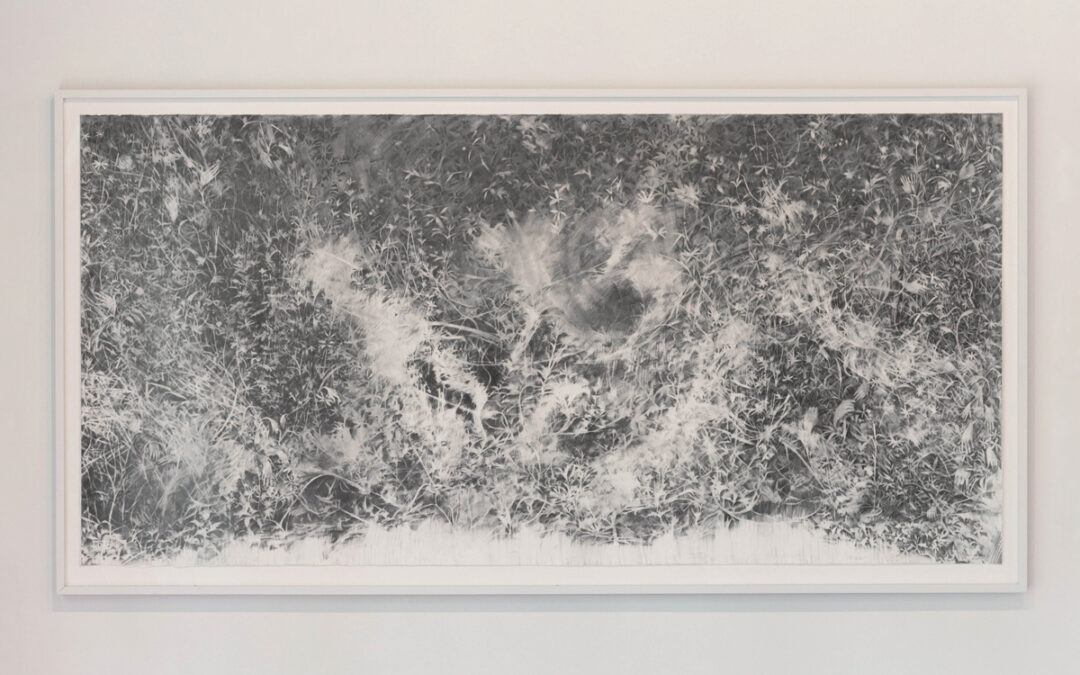
Above: “Caregivers,” graphite on paper, 44 x 90 inches, 2021
“The Future Is Behind Us,” By Rachel Wolfson Smith at Women and Their Work, Austin, TX, Sat Aug 13, 2022 – Thu Sep 29, 2022
Taking a walk in nature, my conscious mind is limited in understanding the intoxicating effects of this overwhelming environment. Something awakens and I experience a greater sense of being in relation to the world. Smelling decaying leaves, moisture in the air, and feeling the chill of the wind, this somatic experience stimulates new thoughts and possibilities. Rachel Wolfson Smith similarly creates this psychological space within her large-scale, intricately detailed drawings. Travelling between Austin, TX and Amsterdam, NL, Smith draws on her personal experiences and activates them within graphite landscapes. In this exhibition, The Future is Behind Us at Women and Their Work, Austin, TX, she contemplates how the evolution of humanity is inextricably linked to the natural world.
This show is organized into three different components: past, present, and future. Starting in the past, the artist reflects on the influence of nature in the Victorian Era 150 years ago. A set of white-framed cyanotypes is displayed, each depicting an explosion of white floral shapes traveling across the surfaces in swirls. Floral bouquets become glowing, starry nebulae.
Cyanotype is a photographic process that was developed in the Victorian Era and most notably used by botanical illustrator Anne Atkins. This context makes Smith’s painted prints appear all the more nostalgic. To create this work, Smith places an object on a chemically coated sheet of paper, exposes it to sunlight and when she rinses the chemical away, the ocean blue of the cyanotype emerges in the exposed areas while other parts remain white with areas of transparency, evoking a palimpsest. Rather than isolating each plant for scientific identification, Smith adjusts the natural artifacts halfway through exposure to create varying transparent layers of foliage. The layout of the resulting image holds gestural movement and draws the eye in organic curves, leading to whispers of babies’ breath and other surprising details such as the silhouette of a bee.
Moving to the present, two free-standing walls in the center of the space present Smith’s iconic, nature-inspired graphite drawings on both sides, ranging in scale from 6×6 inches to 39×28 inches. Holding titles such as “What He Said” and “What She Thought He Said,” the natural world becomes a metaphor for the emotional experience. The small 6×6 inch drawing “Koi” has its own wall, holding its own within the large space. Hands upon hands hold and wrap around each other resembling a swirling feeding frenzy of koi fish in a pond. Each hand-holding gesture is thoughtfully drawn, communicating a calming effect, but when compounded in multitudes, they become eerie and slightly sinister. Are the hands constricting a form beneath or supporting one another? This ambiguity holds emotional weight, as expressions of love can be received either as welcome or smothering.
Two drawings, “Emotional Wall – Nothing’s Wrong” and “Emotional Wall – Melting” are juxtaposed on another wall. Both are similarly composed of ivy on a wall. In “Nothing’s Wrong,” the leaves are crisply rendered and recede into dark shadows. In “Melting,” the leaves are washing away into white, their edges slightly erased, and blurring into bright pinks, yellows, and other colors as the artist introduced colored pencil into her drawings. The articulate strokes in “Nothing’s Wrong,” reveal a keen interest in observational drawing. But the liberation in “Melting” and its use of color transcend the expectation of a representational image and shift it into abstraction. The ability to take the controllable medium of graphite and use crosshatching and erasing as gesturally as painted strokes makes Smith’s work captivating.
On the opposite wall to the cyanotypes, Smith’s chef d’oeuvre, the drawing “Caregivers,” expands almost the entire length at 44 x 90 inches. Layer upon layer of silhouetted foliage cover the entire surface. Ghostly hands emerge between leafy stalks, emulating nature while interacting with it. It is hard to distinguish the human elements from the natural. Towards the center of the work, two large erased areas glow white, obscuring the field and shifting the natural forms into abstracted, layered patterns.
Echoing the cyanotypes, the floral shapes are varying levels of white on a shadowy background. In her artist video, she compares her drawing process to screenprinting, where “specific shapes of light and shadow come together to create forms.” Yet the process of rendering these forms in various shades of graphite takes far longer than cyanotype or screenprinting. During this meditative process, Smith listens to various books and interviews while drawing. Text from these sources appears as written whispers in her drawings. A comprehensive reading list of the books that informed this work is available as a downloadable pdf on the Women and Their Work website, including such books as “Dutch Flower Painting 1600 – 1720” by Paul Taylor and “The Drowned World” by J.G. Ballard.
The back wall holds the future, where the medium changes to sculpture. White boxes meant for new ipads and laptops are repurposed as growing boxes for white ceramic leaves and flowers. The ceramic boxes are displayed on a white shelf while the box covers hang on the wall above them displaying images of ipads, iphones, and other technology. Here Smith poses the question “What is the role of the landscape in the future?” She imagines that in 150 years this could be one way nature is coveted and received– as made-to-order synthetic flowers and leaves. The artist’s hand is evident in each sculpted petal and ivy leaf. Contained within a product box and displayed next to sleek modern images of tech, there is a profound contrast that detracts from the illusion of the tech images and shows how out of touch with reality advertising truly is. The beauty of handmade objects outweighs the sci-fi dream. Even in deathly white, the clay forms echo the earth and remind us of the ecological web we are already part of.
Elements in each section of past, present, and future are translated from cyanotype, to graphite, and to clay. Each holds its unique resonance in conversation with the others. Regardless of the evolving forms, one message remains true: the eternal importance of nature and its necessity in our lives.