Thesis Excerpt (pt. 2): Human as Nature,  Landscape as Memory

Thesis Excerpt (pt. 2): Human as Nature, Landscape as Memory

My Own Immram

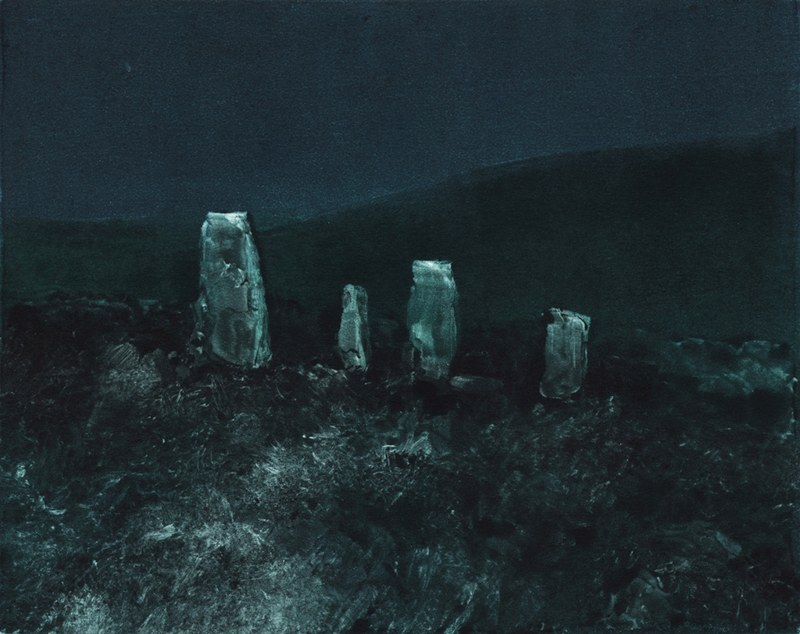
My inspiration for my current investigation in my work began in 2019 when I traveled from my Brooklyn studio to a two-week residency at Cill Rialaig Artist Retreat in County Kerry, Ireland. Staying in a pre-famine cottage on a cliff overlooking the Atlantic coast, I felt the wind and rain come in over Ballinskelligs Bay, and I kept warm by the peat stove. Isolated and removed from the bustling, ever accelerating pace of survival and building a career in NYC, I was reminded of a slower, older time, and more present to every shift in the day and weather and aware of every facet of my own work. I no longer needed to prove myself to the world, I had arrived in my dream life, peacefully making my art in what felt like an otherworld. Above the residency was an east-to-west stone alignment called the Moonstones (Fig. 4.1). I learned about them in the journals left by previous residents. I was advised to walk through a hole in the sheep fence up to the hill, go through the spiral gate, and up to the clearing. The little journey up to the Moonstones felt like entering the fae realm. The air up there felt charged, everything held more weight in a place that time forgot. Standing with these stones which may have been placed there centuries ago for reasons unclear, I looked out to the Atlantic Ocean. The light over many waves took my breath away. Looking at the coast to the south, it felt like the stones were waiting for something to arrive. They created a liminal space, where it was unclear if they were placed by man or natural forces. I spent a few afternoons up there startling sheep while sketching and painting the stones. One sunny afternoon, I ate my packed lunch and took a nap, sheltered from the wind by small boulders and soft grass. I wished I could stay in this peaceful place forever.

Talking with an artist in residence from Ireland, I learned about the stones’ local lore. They were linked to the myth of the Milesians, one of the many waves of mythic peoples to arrive on this island. I realized growing up in the US, I was very familiar with what were called the classics, the Greek myths, and I had heard some Norse mythology, but even as an Irish descendant, I never grew up with the Irish myths. Sure I learned about the saints from my Irish Catholic grandmother (especially her love of Mary and St. Patrick) and even tales of the ‘good folk,’ but not the stories of Lugh or the Morrighan. It was time to find out.

In Dublin after the residency, I purchased Over Nine Waves, a collection of myths retold by Marie Heaney, the wife of prominent Irish poet Seamus Heaney. I read them at the Cobblestone Pub while listening to Irish traditional music. An Irish historical writer there was curious about the text and asked me if it included “Finn and the Salmon of Knowledge,” a story he and those of his generation grew up with. In the story, young Finn meets Finegas, a man fishing for the salmon of knowledge. The salmon lived in the Boyne River and had been eating the hazelnuts that fell from trees around the Well of Wisdom, thus gaining its knowledge. Finally catching the elusive fish, Finegas asks Finn to help cook it and instructs the boy not to eat or touch the fish. While helping, Finn accidentally touches the fish with his thumb and burns it, so he puts his thumb to his mouth to cool it. Finegas sadly tells Finn to go ahead and eat the fish as the knowledge had already passed to Finn in that one accidental move. Gifted with the wisdom of the Salmon of Knowledge, Finn goes on to have many adventures with his band of men, the Fianna, using his clever wit to succeed at many challenges. What interests me about this story is how all worldly knowledge originates from the landscape and makes its way through the ecosystem to us. There is a reverence for the wisdom of the land and perhaps even a belief the landscape has sentience.

Returning to the Moonstones, I also learned the myth of the Milesians and their warrior-bard leader, Amergin. The story goes that in the north of Spain, Ith, a Milesian magician, spots Ireland from the highest tower and sets sail with his men for the island. They explore the beautiful land in awe. He encounters three Tuatha De Danaan kings fighting with each other, so he asks them why fight if they have such a rich land? The skies are blue and sunny, the crops grow abundantly, and the hills and fields continue on as far as the eye can see. At his words they reach peace, so Ith and his men head back to his ship. However, the kings agree that if this leader knows how wonderful their kingdom is, he will come and take it for himself, so they order their men to kill him. His crew vows revenge, returning to their home country to rally reinforcements. They return with the poet and leader Amergin, who challenges the Tuatha de Danaan to the right to their land. They challenge him to give them a fair offer for it, so he agrees to go back to his ship, and if he and his men can sail over nine waves to reach the island, then they will claim it. To thwart him, the Tuatha de Danaan use druid magic to shroud the land in fog and storm, making it impossible to land. Amergin’s ship gets waylaid off the coast and travels so far off course that it sails around the island and, according to local Kerry lore, it makes it as far as Ballinskelligs Bay. Amergin’s brother climbs up to the crow’s nest to look for land, but the storm is so dreadful he is thrown off and dies on deck. In a rage, Amergin calls to the spirit of the land of Ireland, praising its beauty. The storm calms as the island welcomes him. Stepping onto the shore, he speaks his famous poem:

I am the wind on the sea.
I am the wave of the ocean. I am a powerful bull.
I am an eagle on the rock.
I am the brightness of the sun. I am a fierce wild boar.
I am a salmon in the pool. I am the wisdom of art.
I am a spear, sharp in battle.
I am the god that puts fire in the brain.5

After they defeated the Tuatha de Danaan in battle, legend states that his brother was buried on the coast overlooking the ocean, marked by the standing stone alignment, the Moonstones. In this story, the landscape choosing Amergin is what leads them to victory, and the Moonstones may mark the coastline where they were said to be first heralded.

Looking out over the coastal cliffs of Kerry, it felt like the border to the otherworld of Tír na nÓg, told about in many stories of Immrama, where a character travels across the sea to a wondrous land. In “ The Voyage of Bran,” Prince Bran is sitting in a sunny field like the one I napped in by the stones. He hears enchanting harp music, which lulls him into a deep slumber. When he awakens, a silver apple bough is lying next to him. Returning to his castle, a beautiful woman awaits him, and tells him of her enchanted Island of Women and how to navigate the seas there. He sets off immediately with his band of sailors, and they go on a journey with slight obstacles, but most reach the shores of this enchanted land. There they enjoy a happy life in paradise with the beautiful women.

Eventually, one sailor misses his home so much, they all agree to return. When they reach Ireland, the homesick man steps on shore and instantly turns to dust. While it felt like only one year had passed, it had been centuries and they realized they would never set foot on the land again, doomed to sail the ocean for eternity. The crew shouts their tale to a wandering scribe on the shore, who records “The Voyage of Bran” for all to remember.6 At dusk in the cottage, I listened to waves crash below and the distant call of the curlew. It was easy to believe the cry was their lament.

These stories feel like windows to a previous time that a part of me once knew but has forgotten. In their retelling, I relate to the landscape in a different way, one that deepens my connection to places I innately respond to but don’t yet understand.

In addition to the Irish myths, I sought out Irish traditional session music, like the one I heard at the Cobblestone pub in Dublin. After my time in Ireland, I left New York City and moved home to be closer to nature and family in Austin, Texas. Here I found the local Irish traditional session community. While listening to the musicians play on the outdoor patio under the trees, I read the English Surrealist artist Ithell Colquhoun’s journals documenting her travels through Ireland in the 1940s. At one session, a kind bodhran player showed me how to play the instrument, and the moment I struck the drum, thunder actually rumbled and wind shook leaves as a summer storm began. I was enthralled. Returning every week to play the drum with my session friends, I let the music take us to another time and place. I even dreamt of our session once, returning to our familiar Irish pub generations later, where young people listened and unfamiliar musicians still kept the music alive. Playing my bodhran and learning the harp, it feels important to take part in this legacy, of this living dream of people long forgotten. What origin stories do the jigs and reels hold with names like “Kid on the Mountain” or “Earl’s Chair?” It’s like we are holding onto secrets whose keys we forgot long ago, waiting like the standing stones for someone to return over nine waves to remind us what we have held onto—that ancient remembrance and our belonging to sea and stone.

  • Marie Heaney, Over Nine Waves (New York: Farrar, Straus, and Giroux, 1994).
  • Heaney, Over Nine Waves.
Thesis Excerpt (pt. 3): Human as Nature, Landscape as Memory

Thesis Excerpt (pt. 3): Human as Nature, Landscape as Memory

Observations on the Trail

British geographer, Denis Cosgrove defines landscape as the “external world mediated through human subjective experience.” I’d define a place that way. A lived-in landscape becomes a place, which implies intimacy; a once-lived in landscape can be a place, if explored, or remain a landscape, if simply observed. Sometimes a spontaneous attraction to a place is really an emotional response to the landscape, which is place at a distance, visual rather than sensual, seen rather than felt in all its affective power.7

From The Lure of the Local by Lucy Lippard

My work begins with immersing myself in the natural world. When seeing a landscape for the first time, I approach with curiosity and search for hidden moments of light and color around every turn. This heightened sensorial perception becomes a key part of my seeing, and I focus on how natural moments relate to my body through movement, touch, and scent. I use this bodily and mental memory to reimagine these spaces when recreating them in the studio.

When I come across a site that interests me, I spend time drawing or painting directly from observation. If I’m on a long hike, I will bring a small sketchbook to make quick pencil drawings, or if I’m near to where I’m staying, I will bring my supplies and paint en plein air, spending a morning or full day immersed and observing the life that happens there. While painting in a greenbelt outside of Austin, I was startled to see a rabbit run across the path and a coyote trailing close behind. They disappeared into the bushes as the rabbit escaped. Minutes before, joggers and couples had pleasantly walked by, having no idea of the drama at their heels. While spending the day with a place, I enjoy getting to know its secret stories.

This encounter reminded me of a passage in Secrets of the Talking Jaguar by Martín Prechtel. In becoming a shaman, Prechtel’s teacher Chiv assigns him to observe the life happening at his feet at one spot on the ground for an entire day. Martín watches two spiders battling for territory, fighting several rounds. Eventually one kills the other and takes his territory, only to be killed and eaten by a descending wasp, who in turn is eaten by a lizard dropping out of a tree. Then ants clean up the remains.

Anybody who wasn’t able to read the dramatic stories taking place in all nature would never be able to read that nature in human life. This type of looking taught us the shamanic understanding that all beings had to eat and live out their nature. That was a blessing, and that’s how we saw it.8

Observing the will of other life forms takes me out of my human perspective, and I’m aware of the ecosystem we’re all a part of. I feel connected to these creatures who are also just figuring out how to navigate this world.

I am captivated by stories found within the landscapes I dwell, but I also choose to travel to landscapes far from my own that feel like another world. The element of travel shakes me out of my routine. As I adapt to my new surroundings, I’m more attuned to each detail. Seeing a landscape as a traveler, I feel respect and distance from the space. There is a reverence to this type of looking that feels sacred as if on a pilgrimage. Similarly, in describing moments of a ritual, Prechtel writes:

Every movement in the village was synonymous with a ritual edifice where corners and doorways, insides and outsides, were inhabited by the Deities. If you knew how to speak, offer, and move, there were myriad doorways of different styles, and each opened onto the world kingdoms of different Gods and their families. Even if they lived far away at certain times, God places were dangerous, so shamans learned courteous ways to approach these things.9

Before entering new terrain, I research local lore, myths, and legends for inspiration. I’m interested in learning how others saw the site before me. Perhaps it will tell me a little about the people who have lived here, their perspectives and experiences. In Looking for the Hidden Folk, Nancy Marie Brown explains how places and place names hold stories. For instance, if you read the Icelandic sagas, it would be hard not to see the stories everywhere in Iceland. She writes:

As you hike south from Stykkisholmur, through the rain and the mud, your backpack heavy, greylag geese honking mournfully overhead, and your eye catches sight of the sheer north face of Helgafell, itself catching a low glimmer of sunlight slipping between the leaden clouds, it’s impossible not to imagine, if you’ve read Eyrbyggja Saga, the side of the hill opening up like doors.10

As well as sagas, personal stories also find root in the landscape; the life you live there becomes part of its lore to you.

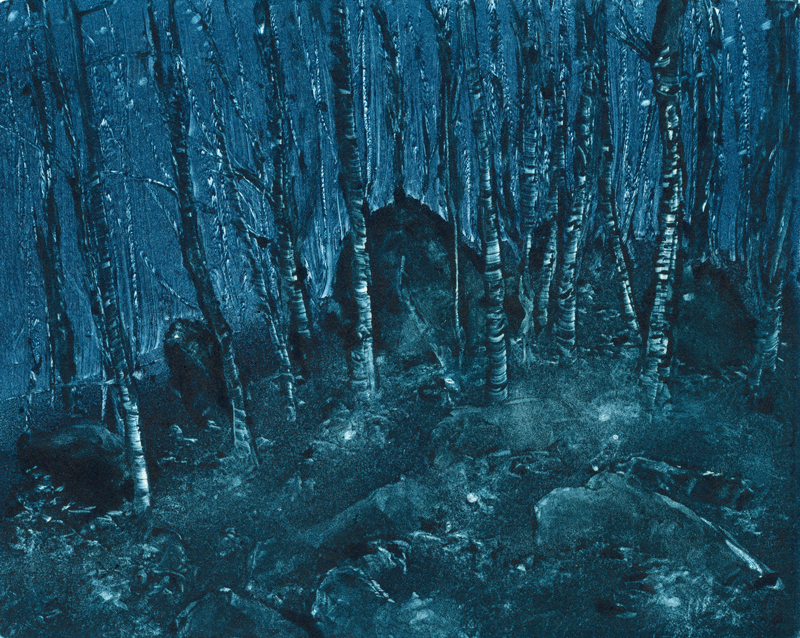
In Norway, it was no surprise to read about giants after seeing the scale of their cliffs above the fjords. No other being could have inhabited this space, humans are too tiny. And in discovering dark crevices that still hold sheets of ice where the temperature drops 10 degrees in mid-summer, I could understand believing ice giants lived there. Once, I looked down a cliff at the massive waterfall, Vøringfossen, whose mist created massive arcing rainbows that went from sky to ground. No wonder there were Norse myths of a rainbow bridge connecting realms. On a hillside, the massive boulders covered with moss glimpsed through trees held so much personality and presence (Fig. 5.1). They could be sleeping trolls turned to stone during the day, waiting to awaken. Through this lens, the landscape becomes a living myth.

Stories like these build worlds. Brown quotes S. Leonard Rubinstein in his book, Writing, A Habit of Mind:

We are born and we die. An unbroken line stretches from one to the other. Yet we are able to say, “I had a strange experience the other day.” What enables us to take a segment of that unbroken line and call it an experience?11

It is our ability to weave stories by selectively remembering important moments to create a narrative. And with our stories about a landscape, we can protect the place.12

  • Lucy Lippard, The Lure of the Local (New York: New Press, 1997), 7-8.
  • Martín Prechtel, Secrets of the Talking Jaguar: Memoirs from the Living Heart of a Mayan Village (New York: Jeremy Tarcher/Putnam, 1998), 150.
  • Prechtel, Secrets of the Talking Jaguar,
  • Nancy Marie Brown, Looking for the Hidden Folk (New York: Pegasus Books, Ltd, 2022).
Return to Jentel Artist Residency

Return to Jentel Artist Residency

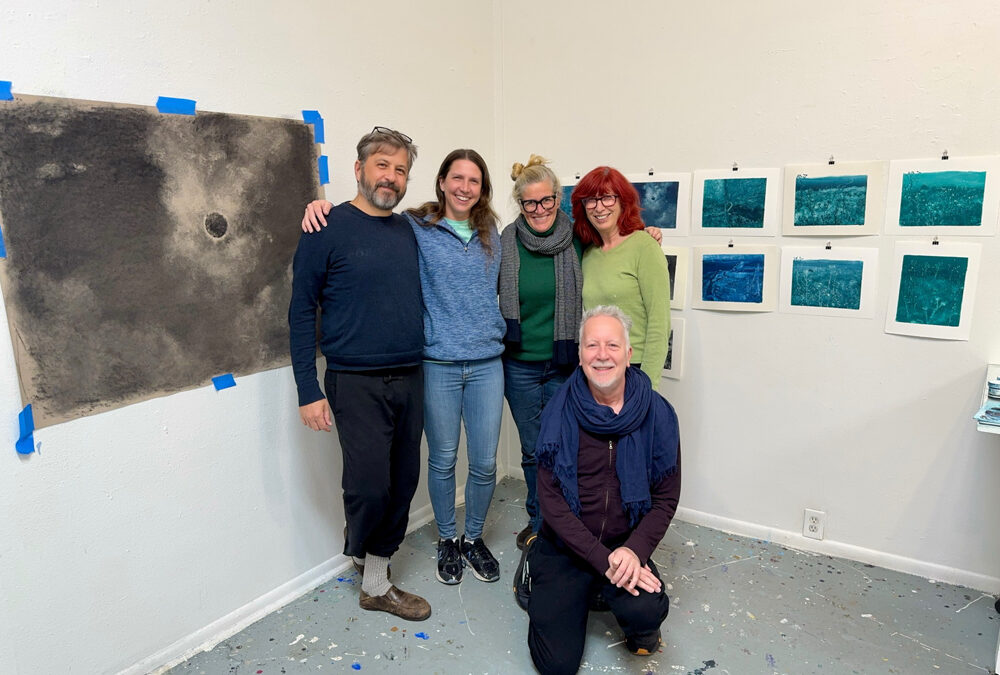
In September 2021, I was invited to Jentel Artist Residency in Banner, Wyoming. I spent a month creating artwork alongside artists Karen Marston, Amy Robson, Frank Sheehan, and writer David Naimon. Inspired by our time together, we proposed a group show for Sage Gallery in nearby Sheridan, WY. They offered us a show and we were generously invited back to Jentel for a residency at the same time. I returned to Jentel 3 years later with my dear friends in October 2024 for the opening of our show, Conversation in the 1000 Acres at Sage Gallery. Once again based in the wild foothills of the Bighorns, I spent my time hiking and responding to the landscape from my new perspective as a recent Studio Art MFA graduate.

I loved the space to think, absorb, and become inspired. I loved the landscape and how the light always changed over the hills and mountains. I loved listening to the sound of the water as I read by the creek and spending time with my friends talking about our art and writing over delicious homemade meals.

For the past two years, I have analyzed my work from every angle and evolved my process continuously. At Jentel, I had the time and space to pause and reflect on my MFA experience and make work purely for the joy of it. It gave me time to take stock of where I am at in my work and examine many of the avenues of expression I utilize: monotype, painting, oil pastel, and charcoal drawing. Seeing everything on the walls together, I realized I am at a point of expansion. I am excited to continue new processes this experimentation has opened up, such as creating a monotype with gold ink and then layering acrylic paint and oil pastel on top to create an image of fields of sage. My time there helped me set my own pace and to re-orient myself as I return to the world beyond grad school.


Assisi International Contemporary Art Exhibition 2024

Assisi International Contemporary Art Exhibition 2024

After our artist residency at Arte Studio Ginestrelle in Assisi, Italy, my monotypes and my partner Sam Teeter’s poems were included in the XV edition of Assisi International Contemporary Art Exhibition 2024 at Art Gallery Le Logge, Palazzo dei Priori, from August 29th to September 1st, 2024, curated by the artist residency director, Marina Merli.

Arte Studio Ginestrelle in Assisi, Italy

Arte Studio Ginestrelle in Assisi, Italy

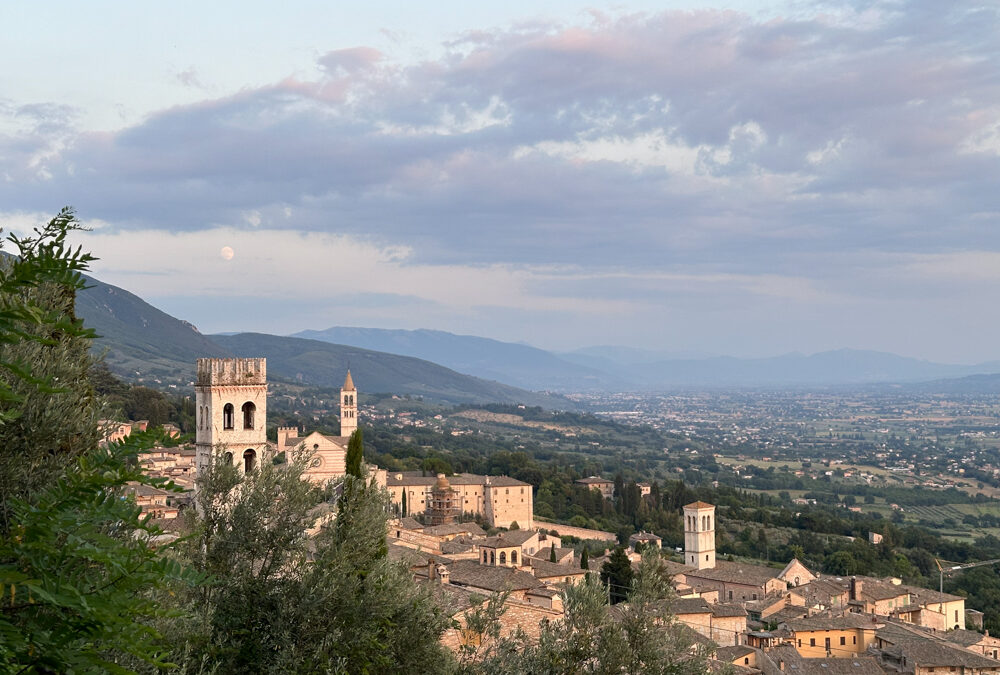
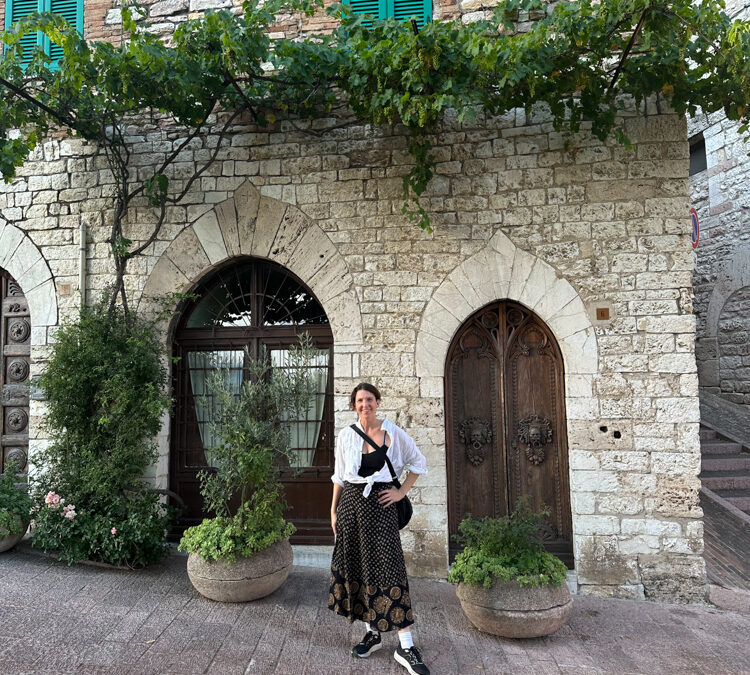
In July 2024, my partner, Sam Teeter, and I traveled to Assisi, Italy as artist-and-writer in residence at Arte Studio Ginestrelle, founded by Marina Merli. We spent the week creating work and exploring this sacred village and its many winding cobblestone paths, forts, cathedrals, and the Roman and Etruscan archaeological sites below. As St. Francis is the patron saint of animals and nature, this hillside village was overflowing with greenery, with olive groves and grapevines abounding over stone walkways. There were many adorable cats to be found, taken care of by the lady next door to us. We hiked the Bosco di San Francesco, a forest path and nature preserve connected to St. Francis Basilica. It led to the adjoining grounds of the Benedictine chapel, Chiesa Santa Croce. Here the land was turned into olive groves and orchards as a sanctuary for travelers.

My monotypes were heavily influenced by these sights, especially the lushness of the olive trees and the everpresent layering of history found in the landscape. Our residency was even built with stone previously used for Roman buildings. In the work I made here, I responded to the local environment and drew on my collected research from my recent travels through Rome, Florence, and Siena. I studied the Tuscan landscape and the ways it was portrayed in Renaissance paintings to create a series of landscape-inspired gel-plate monotypes and drawings that capture the emotion and energy of my experiences within these places, particularly Assisi  In my work, I also used gold ink to evoke the ever-present gold-leaf found in the Byzantine and early Renaissance paintings found in the many cathedrals.

On our last night, Sam and I encountered a group of musical therapy students playing music in the square outside San Rufino Cathedral. Despite the language barrier, I communicated that he plays the fiddle, and immediately one of the musicians handed him her instrument. They delighted in his playing and many joined in while others invited me to dance. We ended the evening enjoying cookies brought out to us by nuns and sharing our stories in broken English and Italian. I cherish our adventures here and hope we shall return.